
Carbodiimide for Polyamide (PA) Applications
Enhance the durability, hydrolysis resistance, and long-term stability of polyamide and engineering plastics with our advanced carbodiimide anti-hydrolysis agents.
Nylon: An Indispensable Engineering Plastic
As a large amount of engineering plastics, nylon is widely used in machinery, automobiles, electrical appliances, textile equipment, chemical equipment, aviation, metallurgy and other fields. It has become an indispensable structural material in various industries, and its main features are as follows:
Excellent Mechanical Properties
Nylon has high mechanical strength and good toughness, making it ideal for demanding structural applications across multiple industries.
Self-Lubricating & Friction Resistant
Nylon has good self-lubricity and a low friction coefficient, giving transmission components a long service life under continuous operation.
Excellent Heat Resistance
Highly crystalline nylon such as PA46 has a high heat distortion temperature and can operate long-term at 150°C. Glass-fiber-reinforced PA66 exceeds 250°C.
Electrical Insulation
With high volume resistance and high breakdown voltage resistance, nylon is an excellent insulation material for electrical and electronic applications.
Excellent Weather Resistance
Nylon retains its performance across a wide range of outdoor and environmental conditions, delivering long-term reliability in exposed applications.
Water Absorption
Nylon has high water absorption, with saturated water reaching more than 3%, which can affect the dimensional stability of finished parts to a certain extent.
Enhanced Hydrolysis Resistance for PA66
The addition of HyMax® 213 can significantly improve the hydrolysis resistance of PA66. With the increase in the amount of addition, the mechanical properties of PA66 are significantly improved.
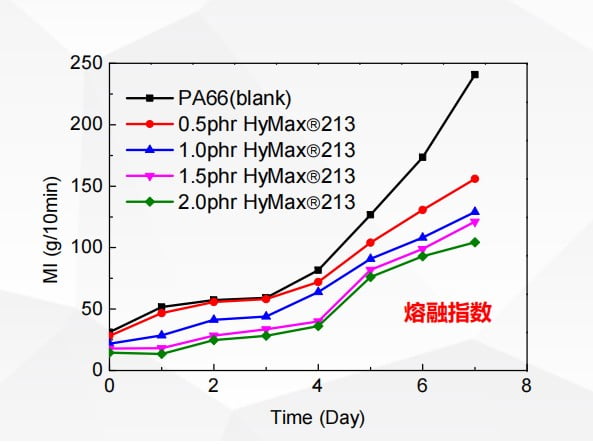
How carbodiimide protects PA
Our HyMax carbodiimide compounds react with carboxyl end-groups generated during hydrolysis, neutralizing the degradation cycle and preserving polymer chain integrity.
Carboxyl End-Group Capping
Carbodiimide reacts with free -COOH groups on PA chain ends, forming stable acylurea bonds and preventing further chain scission.
Catalytic Inhibition
By reducing -COOH concentration, carbodiimide removes the autocatalytic driver of PA hydrolysis, slowing degradation exponentially.
Long-Term Stabilization
Molecular weight is maintained over extended service periods, preserving tensile strength, impact resistance, and dimensional stability.
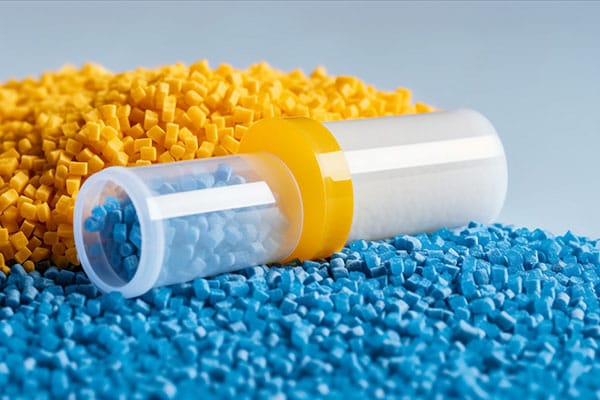
PA application sectors
Our carbodiimide solutions are proven across multiple demanding PA end-use markets.
Automotive
Engine covers & intake manifolds
Electronics
Connectors & terminal blocks
Industrial
Gears, bearings & conveyors
Consumer Goods
Sports gear & tool housings
Contact Us
Phone
+86 021 6779 9023Address
No.3 Building, No.136, Yuxiu Road, Songjiang, Shanghai, China, 201699