
Application of
Hydrolysis Stabilizer in PET/PBT
Discover how HyMax® hydrolysis stabilizers protect PET, PBT, and other polyester materials from moisture-induced degradation — extending product lifespan across demanding industrial applications.
PET & PBT Polyester Materials
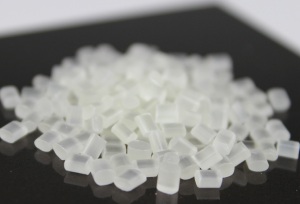
Both PET and PBT are polyesters.
PET has a highly compact molecular structure and a certain plastic synthesis ability, so it has good non-film and film-forming properties.
In addition, PET plastic has excellent wear resistance, friction, size and stability. Bottles made of PET have high strength, good transparency, non-toxicity, anti-permeation, light weight, and high production efficiency, which are widely used.
But the fatal shortcoming of PET is that its hygroscopicity is relatively high, and under wet conditions, the characteristic bonds in the molecule are prone to shrink and recover, resulting in a decline in overall performance and an extension of life.
PBT molecular chain structure and many characteristics are similar to PET, but its electrical insulation and durability are more common, so it is used for electronic and electrical shells, parts shells, mechanical equipment shells, automobiles, etc.
The hygroscopicity of PBT is relatively low, but it is also not prone to problems under humid and hot conditions.
HyMax® 1010 in PET Applications
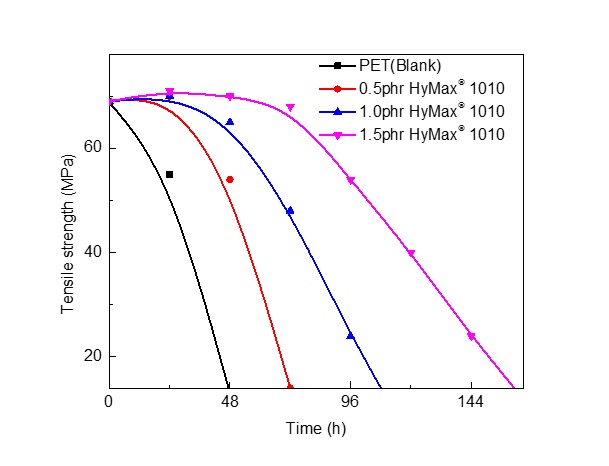
HyMax® 1010 can significantly improve the hydrolysis resistance of PET materials, especially if the addition amount is ≥1.0%. As the addition amount increases, the hydrolysis resistance performance improves.
- Significantly improves hydrolysis resistance at ≥1.0% addition
- Performance scales proportionally with dosage
- Suitable for humid and high-temperature environments
- Compatible with standard PET/PBT processing conditions
Industrial Monofilament: PET & PBT Monofilament Hydrolysis Control
Monofilament works harder than most polyester articles. Paper machine clothing runs in saturated steam above 100 °C; filter mesh is cleaned in hot caustic; fishing line and aquaculture netting sit in salt water under UV for years. In each case the mechanism is the same -- ester bonds break, carboxyl end groups build up, and those acids accelerate further hydrolysis. Strength holds, then drops away.
HyMax carbodiimide anti-hydrolysis agents are added at the spinning stage to react with those carboxyl groups and interrupt the cycle. Both monomeric and polymeric grades are available, as powder or as ready-to-dose PET anti-hydrolysis masterbatch (HyMax M10, M20) for direct addition on standard monofilament lines.
Typical dosage starting point
For PET/PBT: ≥ 1.0 % addition, with hydrolysis resistance improving as dosage rises. Exact dosage should be set against your target service life and tracked by carboxyl end group (CEG) content.
Recommended Products
Where Hydrolysis Stabilizers Make a Difference
Electronics
Electrical shells & components
Automotive
Parts & structural components
Packaging
PET bottles & films
Industrial
Machinery & equipment
Contact Us
Phone
+86 021 6779 9023Address
No.3 Building, No.136, Yuxiu Road, Songjiang, Shanghai, China, 201699