
Application of Hydrolysis Stabilizer in Polycarbonate (PC)
Polycarbonate is prized for its clarity and impact strength, but degrades in humid, high-temperature environments. Our carbodiimide-based stabilizers protect PC from hydrolysis, extending its service life and durability.
Understanding PC and Its Hydrolysis Weakness
PC (polycarbonate) is a carbonic acid polyester with many types, mainly formed by polycondensation of bisphenol A and diphenyl carbonate or dimethyl carbonate. PC is an almost colorless glassy amorphous polymer with good optical properties. It is widely used in the production of optically transparent parts such as photographic equipment, aircraft cockpit glass, high-speed aircraft windshields and sunroofs, car lights, etc.
Optical Clarity
As a transparent material, the surface of PC is not easy to scratch and has good comprehensive mechanical properties.
Strong Mechanics
Tensile, compression, and bending strength are equivalent to PA66, and the impact strength is very high, higher than PA and most engineering plastics.
Thermal Range
PC has good heat resistance. The heat distortion temperature is greater than 126°C. PC has good cold resistance. It can work for a long time at minus 70°C. The body thermal conductivity and specific heat capacity are centered in the plastic. It is a good thermal insulation material.
Electrical & Flame
PC is an insulating material with better electrical properties. It can maintain good electrical properties in a wide temperature range. PC has good flame retardant properties. It can burn slowly in the flame but can suffocate and self-extinguish away from the fire.
Chemical Resistance Profile
The chemical properties of PC are good, aliphatic hydrocarbons and oils. Most alcohols have no effect on it, and are resistant to dilute acids, salts, and oxidants, but are not resistant to alkalis.
Hydrolysis Under Heat and Humidity
The main performance defect of PC is that the stability of hydrolysis resistance is not high enough, and it will hydrolyze and yellow when exposed to hot and humid environment for a long time. This is because the ester bond in the PC molecular chain is prone to hydrolysis reaction with carboxylic acid or water under damp and heat conditions, causing the molecular chain to break, which in turn causes the overall performance of the PC material to decrease and the service life to shorten.
HyMax®1010: Stopping Hydrolysis at the Molecular Level
HyMax®1010 product can react with the terminal carboxyl groups of PC and the carboxylic acid produced by the decomposition of PC to produce stable urea-based compounds without side effects. This slows down the progress of polymer hydrolysis, prolongs the service life of the polymer, and solves the problem of the overall performance degradation of PC materials caused by hydrolysis.
Captures terminal carboxyl groups
Forms stable, side-effect-free compounds
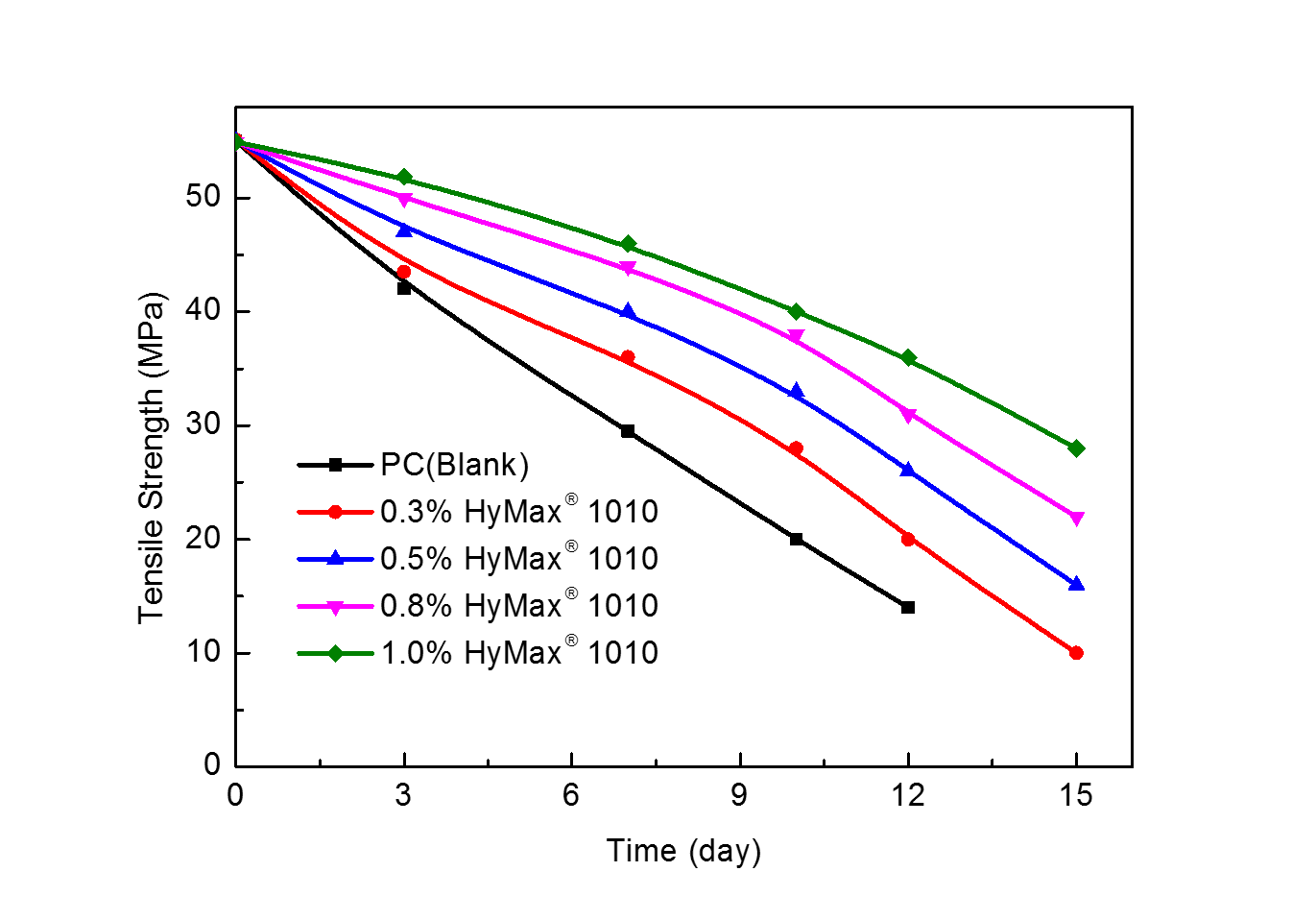
Key advantages for PC applications
Retained Impact Strength
Maintains >85% notched Izod impact strength after 1000 hours at 85°C/85% RH aging conditions.
Optical Clarity Preserved
Prevents haze development and maintains light transmittance above 88% throughout the product lifecycle.
Thermal Stability
High decomposition temperature ensures stability during PC melt processing at 280-320°C without off-gassing.
Low Migration
Polymeric structure ensures minimal blooming or extraction, ideal for food-contact and medical-grade PC parts.
Easy Processing
Compatible with standard extrusion and injection molding processes. No special equipment required.
Extended Service Life
3-5x improvement in humid-heat aging performance, significantly reducing warranty claims and material failure.
Where PC hydrolysis stabilizers make a difference
Our carbodiimide solutions deliver proven performance across demanding polycarbonate end-use markets.
Automotive Lighting
Headlamp lenses & sunroofs
Electronics & Electrical
Connectors & LED diffusers
Construction
Multi-wall sheets & skylights
Medical Devices
Sterilizable instruments & housings
Contact Us
Phone
+86 021 6779 9023Address
No.3 Building, No.136, Yuxiu Road, Songjiang, Shanghai, China, 201699