
Do you find your TPU products losing their strength and failing prematurely due to water damage? Many manufacturers struggle with hydrolysis1, a process that significantly shortens product life.
Using an anti-hydrolysis TPU masterbatch2 greatly improves the durability and useful life of polyester-based TPU3 products by actively shielding them from water degradation, keeping their mechanical properties intact over time.
We seen many companies face challenges with TPU hydrolysis1. We want to show you how learning about its causes and applying the right additive can make a big change in your product's performance and reputation.
What is TPU Material, Really?
Are you wondering what makes TPU so important and used everywhere? A lot of people think it is just another plastic, but it is much more complex.
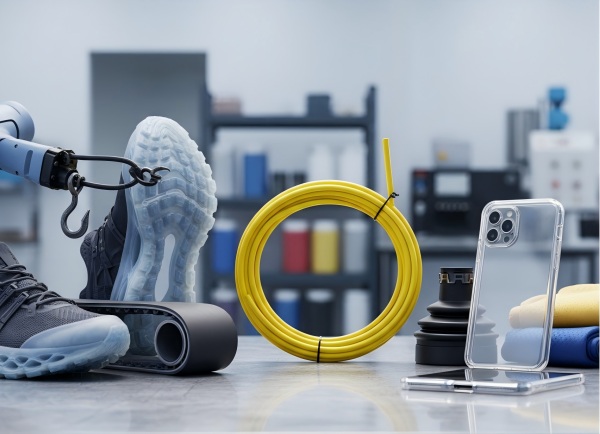
TPU, or Thermoplastic Polyurethane, is a special polymer that combines the best parts of plastics and rubber; it gives you high elasticity, clear transparency, and strong resistance to oil, grease, and rubbing.
When I first joined Langyi, I remember Dr. Tang explaining how TPU's molecular structure lets it be both tough and stretchy. It is like having a material that can stretch a lot and then go back to its original shape without breaking. This double nature comes from its parts, called segmented block copolymers. One part is a "soft segment" that makes it flexible, and the other is a "hard segment" that gives it strength. Knowing this basic structure helps you understand why it acts the way it does.
Breaking Down TPU's Core Structure
TPU gets its special qualities from its chemical makeup.
- Soft Segments:
- Job: They make it elastic and flexible.
- Examples: Polyether or polyester macrodiols are common.
- Effect: This part decides how soft the material is and how well it works in cold.
- Hard Segments:
- Job: They provide strength, hardness, and resistance to chemicals.
- Examples: Diisocyanates and chain extenders are key.
- Effect: This part affects its melting point, stiffness, and how strong it is overall.
This mix lets TPU be very useful. My team and I often talk about how this balance makes TPU good for many things, from phone cases to medical devices. This balance also makes it simple to process, which is a big benefit for manufacturers.
| Property | Soft Segment Role | Hard Segment Role |
|---|---|---|
| Elasticity | High | Low |
| Hardness | Low | High |
| Flexibility | High | Low |
| Rubbing Resistance | Medium | High |
| Chemical Resistance | Medium | High |
Is TPU a Strong Material, in Practice?
Do you ever question if TPU can truly handle tough treatment and last a long time? Many users doubt its long-term strength, especially when thinking about stiffer plastics.
Yes, TPU is a very strong and lasting material, known for its great pulling strength, tear resistance, and high resistance to rubbing, making it right for hard-working uses where flexibility and bounce are vital.
Back when we made our first products, we saw how TPU handled strong tests. We would push it to its limits, twisting it, stretching it, and rubbing it on rough materials. It always did better than many other polymers in terms of strong mechanical qualities. Its strength comes from how its hard and soft parts work together at a molecular level. They form a kind of inner net that resists changing shape and damage. This is why you often find it in high-performance sports items or industrial components.
Unpacking TPU's Durability Characteristics
TPU shows strength in many ways, not just one.
- Pulling Strength:
- Meaning: How much pulling force it can stand before breaking.
- Effect: High pulling strength means it resists stretching and staying stretched out.
- Use: Important for things like conveyor belts or cables.
- Tear Resistance:
- Meaning: How well it resists tearing once a small cut or scratch begins.
- Effect: Stops small damages from becoming big failures.
- Use: Very important for protective films and flexible tubes.
- Rubbing Resistance:
- Meaning: How much wear and rubbing it can stand without wearing out.
- Effect: Keeps products looking good and working well even with constant use.
- Use: Key for shoe soles, tool handles, and car parts.
These different strengths combine to make TPU an incredibly dependable material. My co-workers and I often point out these features to clients because they directly lead to products lasting longer and being better to use. It is more than just strong; it is tough and bounces back.
| Strength Type | Common Values (about) | Real-World Use Example |
|---|---|---|
| Pulling Strength | 30-60 MPa | Sports gear straps, drive belts |
| Tear Strength | 50-150 kN/m | Protective gloves, flexible tubes |
| Rubbing Resistance | Excellent | Office chair wheels, heavy-duty hoses |
| Stretch before Break | 300-700% | Elastic bands, flexible medical devices |
What are the Different Grades of TPU?
Are you confused by all the kinds of TPU and wondering which one is right for your product? Many people wrongly think all TPUs are the same, which leads to choosing the wrong materials.
TPU comes in many types, mainly different by their main chemical structure (polyether or polyester) and how hard they are (Shore A to Shore D). Each type offers specific qualities good for different jobs.
At Langyi, I have personally seen how choosing the right TPU type deeply affects how well a product works. Early on, I learned that polyether-based TPUs resist hydrolysis1 better in wet places, while polyester-based TPU3s are great for resisting oil and chemicals. This difference is key for engineers picking materials. For example, a medical device needing to be safe for bodies and resist water would use a polyether TPU. A car part exposed to fuels would use a polyester TPU. Each type has its own story of strengths and weaknesses; there is no single answer for all needs.
To understand TPU types, we look at their chemical families and how hard they are.
- Polyether-based TPU:
- Qualities: Very good resistance to water breakdown, good flexibility in cold, great resistance to microbes.
- Uses: Cables, foam, shoes, farm equipment parts.
- Note: A bit less resistant to oil and chemicals compared to polyester.
- Polyester-based TPU:
- Qualities: Great mechanical strength, high resistance to rubbing, good resistance to oil and chemicals, better aging in heat.
- Uses: Car parts, industrial seals, hoses, sports goods.
- Note: More likely to break down from water in humid or hot places.
Then there is hardness, measured by the Shore scale. This tells us how stiff or stretchy the material is. A low Shore A number means very soft, like a gel. A high Shore D number means it is quite stiff, more like a hard plastic. My team often works with clients to accurately match these features with what their product needs, making sure it works best and lasts longest for every use.
| Type of Grade | Main Feature | Best Advantage | Normal Hardness Range |
|---|---|---|---|
| Polyether TPU | Resists water breakdown | Great water resistance | Shore A 60 - Shore D 70 |
| Polyester TPU | Mechanical strength | High resistance to rubbing/chemicals | Shore A 70 - Shore D 80 |
How to Improve your Polyester TPU with Anti-Hydrolysis Agent?
Are you seeing frustrating early product failures in your polyester TPU items, especially in damp or wet conditions? Many overlook how much hydrolysis hurts product quality.
To greatly boost polyester TPU’s resistance to water breakdown and make it last longer, use a carbodiimide-based anti-hydrolysis agent4. This agent chemically reacts with water and makes it harmless, thus protecting the polyester bonds from breaking down.
I clearly remember a time when a client, who made outdoor gear, had trouble with their TPU coatings cracking too soon. Their products, made from polyester TPU, failed after only a few months of use outside. We suggested adding a carbodiimide anti-hydrolysis agent, and the results were amazing. The agent acts like a "water catcher," stopping water from attacking the ester bonds in the TPU. It is like giving your TPU an invisible shield against moisture, which is the main reason it breaks down. This simple addition made their product much tougher, making it last long and be trustworthy even in the harshest places.
The Science Behind Carbodiimide Anti-Hydrolysis and Easy Dispersion
Carbodiimide agents work at a basic chemical level to protect your TPU. However, getting these agents mixed in well can be tricky. This is where a masterbatch helps.
- Mechanism of Action:
- Carbodiimide molecules actively look for and react with any water molecules in the TPU.
- They create stable, harmless byproducts instead of letting water react with and break the polyester chains.
- This "sacrificial" action keeps the TPU's molecular structure whole.
- Benefits for Polyester TPU:
- Longer Life: Products last much longer, especially in humid or wet places.
- Maintained Strength: Things like pulling strength, flexibility, and stretch stay good over time.
- Better Heat Stability: It can also help improve how well it resists breaking down in higher heat.
- Dispersion Advantage with Masterbatch:
- Anti-hydrolysis agents are not always easy to spread evenly into raw TPU. This can leave weak spots.
- Adding the agent in a polyol or as an anti-hydrolysis TPU masterbatch2 solves this. This means the agent is already well mixed into a compatible base.
- This ensures the protective agent is spread uniformly throughout your final product, giving consistent and reliable anti-hydrolysis protection.
At Langyi, we focus on offering these carbodiimide solutions, often in a masterbatch form, because we have seen how well they work consistently. Our team often explains that it is not just about adding an ingredient; it is about introducing a chemical safeguard that actively works to give your polyester TPU the same toughness against water often seen in polyether types. The masterbatch approach specifically makes it easier for you to use, guaranteeing that your products perform well and dependably for many years.
| Aspect | Without Anti-Hydrolysis Agent | With Carbodiimide Anti-Hydrolysis Agent |
|---|---|---|
| Hydrolysis Resistance | Poor to Medium | Great |
| Product Lifespan | Shorter | Much Longer |
| Maintained Strength | Breaks down over time | Keeps strong performance |
| Easy Dispersion | Can be hard | Easy with polyol or masterbatch |
| Use in wet places | Limited | Much more suitable |
Conclusion
Carbodiimide anti-hydrolysis agents are vital for boosting polyester TPU performance. They ensure your products stay strong and last longer, especially when delivered via a well-dispersed masterbatch.
---Understanding hydrolysis is crucial for improving product durability; this resource provides in-depth insights. ↩
HyMax MTPU20 anti-hydrolysis TPU masterbatch. ↩
Learn about the unique properties of polyester-based TPU and its applications in various industries. ↩
Learn about the chemical mechanisms of carbodiimide agents and their role in enhancing TPU durability. ↩